


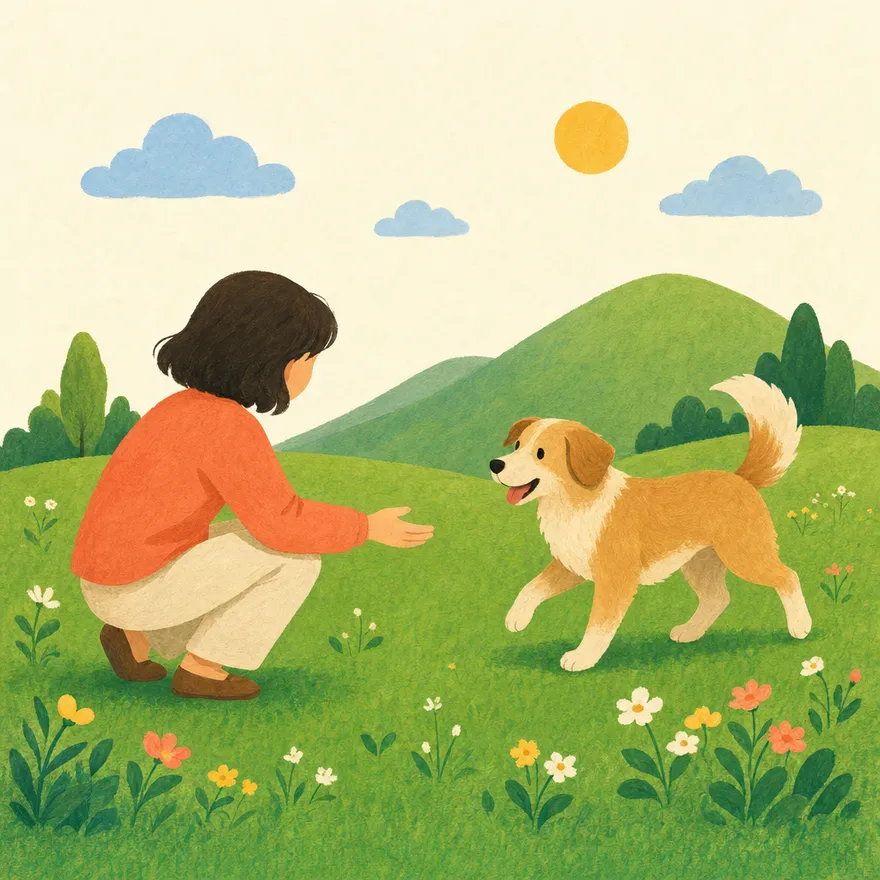
How to know if you're ready for a dog
The quiz gives you a score. This is the reasoning behind it — the seven things that decide whether a dog thrives with you or ends up back at the shelter.
Nobody is ever completely ready for a dog, in the same way nobody is completely ready for anything good. But readiness isn't a feeling — it's a set of conditions you can check honestly, before a living animal depends on them. Behavioural issues, housing and simply not being able to afford care are the three reasons dogs are given up most often, and every one of them is easier to spot now than in month seven.
Time — specifically, time alone
The single most predictive question isn't "do I love dogs", it's "how many hours a day will this dog be by itself?" The RSPCA's guidance is a maximum of four hours for an adult dog, and far less for a puppy who can't hold a bladder that long. Research they cite suggests around eight in ten dogs find being left alone hard, and roughly half of those show no obvious signs — no howling, no chewing, just a dog quietly stressed in an empty room.
Being alone is a skill, and it has to be taught in tiny increments — seconds, then minutes — long before the day you actually need it. If your work pattern means eight-hour absences, that's not automatically a no: a midday walker, daycare two days a week, or a genuinely dog-friendly office all change the maths. Vague optimism doesn't.
Money — the boring answer that decides everything
Typical annual spend for a dog runs somewhere between about $1,200 and $4,300, depending on size, health and where you live; Rover's 2025 owner survey put the range as high as $5,295 and found costs rising roughly 15% in a year, with US vet services alone up 5.3% year on year in early 2026. Then there's year one: adoption or purchase fee, neutering, vaccinations, microchip, crate, bed, leads, and — please — training classes.
The number that matters most isn't the monthly one. It's whether you could say yes to a $2,000 emergency tomorrow without it wrecking you. Pet insurance taken out before anything is wrong, or a dedicated savings buffer, is the difference between a treatable problem and an impossible choice. Financial strain is one of the most common reasons dogs are surrendered, and it rarely announces itself in advance.
Energy — match the dog to the life you actually live
"Enough exercise" is meaningless without a breed attached to it. A retired greyhound is famously happy with two short walks and a sofa. A working-line collie, spaniel or malinois needs a job, not a lap of the park, and will invent a distressing one if you don't provide it. Be honest about the life you live in February, not the one you imagine in June.
Heat is where good intentions become dangerous. In a study of 905,543 UK dogs, exercise — not hot cars — triggered 74% of heat-related illness cases, and 14.2% of affected dogs died. The average conditions weren't extreme either. Flat-faced breeds and older dogs can overheat simply sitting outside. In summer, walk early or late, keep it short, and test the pavement with the back of your hand before you set off.
Home — and everyone in it
Check the boring things first: does your lease allow dogs, in writing? Is there somewhere the dog can be left safely and comfortably? Are there stairs a senior dog will struggle with, a garden that isn't actually secure, a housemate with allergies?
Then check the human ones. A dog that one person in the household didn't want is a dog with inconsistent rules, resentment attached to every accident, and a much higher chance of being rehomed. Everyone living with the dog needs to be a genuine yes — including on who does the 6am walk in the rain.
A backup plan with a name in it
You will get the flu. You will be sent away for work. There will be a funeral, a hospital stay, a delayed flight. "I'd figure something out" is not a plan — a specific person who has already said yes, or a boarding kennel and sitter you've researched and budgeted for, is. Sort it before the dog arrives, not during the emergency.
The next ten to fifteen years
A medium-sized dog will likely be with you for 10–13 years; many small breeds pass 15. That's a whole chapter of your life: possible moves, a possible baby, a change of job, a change of country. None of those disqualify you — plenty of people move house and change careers with a dog beside them. What matters is whether you'd plan around the dog when it happens, and whether you can say that honestly while nothing is actually at stake.
What you'd do when it goes wrong
Readiness isn't only circumstance — it's knowing the handful of things that turn a bad day into a catastrophe. What you do in the first ten minutes after a dog eats chocolate. Whether you can spot the difference between a dog who's fine and a dog who is asking a child to stop. Whether you know that unproductive retching plus a swollen belly is a drive-to-the-vet-now emergency, not a wait-and-see one.
Almost every bite is preceded by signals the human missed: a head turn, a lip lick, whale eye, a freeze. And a growl is not bad behaviour — it's a free warning. Punish it and you get a dog who skips the warning next time. The good news is this is all learnable in an afternoon, which is roughly what the quiz above is for.
What the research says
- 3–14 weeks is the window. The American Veterinary Society of Animal Behavior puts the critical socialisation period in a puppy's first three months, when sociability outweighs fear — and says socialising before full vaccination should be the standard of care, done safely. AVSAB position statement
- How you train changes the dog. In a study of 92 companion dogs, those trained with aversive methods showed more stress behaviours and higher post-training cortisol; where aversives were used heavily, welfare was worse outside training too. Vieira de Castro et al., PLOS ONE (2020)
- Exercise causes most heatstroke. Across 905,543 UK dogs under veterinary care, 74.2% of heat-related illness was triggered by exertion versus 5.2% by hot cars — and 14.2% of affected dogs died. RVC VetCompass / Nottingham Trent (2020)
- Behaviour is the top reason dogs are given up. A content analysis of shelter records from 2018–2023 found behavioural issues (28%), housing (18%) and inability to care (16%) leading the reasons for relinquishment. Animals (2024)
- The "puppy blues" are real and common. A University of Helsinki study of more than 2,000 owners found nearly half report significant negative feelings after a new puppy — anxiety, frustration, weariness — with about 10% experiencing them severely. They usually pass. npj Mental Health Research (2024)
- Alone time is a welfare issue. The RSPCA advises leaving an adult dog no longer than four hours, and notes that many dogs who struggle show no visible signs. RSPCA guidance
Signs you're ready
- You know roughly what the first year will cost, and you've checked it against your actual account.
- You can name the person covering your dog when you're ill or away.
- Everyone in your household wants this, including the person who'll do the rainy walks.
- You've picked a breed or type for the life you have on a Wednesday in February.
- You've budgeted time for training classes, not just walks.
- You're excited about the boring parts: the routine, the vet visits, the same field every morning.
Signs to wait a while
- A $2,000 vet bill tomorrow would be genuinely impossible.
- Your housing is uncertain, or your lease doesn't clearly allow dogs.
- You'd be out of the house 9+ hours with no walker, sitter or daycare.
- You're in the middle of a big life change — moving, new baby, new job with unknown hours.
- You want the dog mainly to fix something: loneliness, a relationship, a child's boredom.
- Nobody in the house has time to train, and the plan is "they'll settle down".
Waiting isn't failing. A dog adopted into the right year instead of the wrong one is the whole point.
Am I ready for a dog? FAQ
How do I know if I'm ready to adopt a dog?
Check five things honestly: how many hours the dog would be alone each day (aim for four or fewer), whether you could absorb a sudden $2,000 vet bill, whether your housing allows dogs long-term, who your named backup carer is, and whether everyone you live with genuinely wants a dog. If four of those five are solid, you're in good shape. The quiz above scores exactly these, plus what you'd do in eight common situations.
Should I get a dog if I work full time?
Yes, if the day is broken up. Full-time work is compatible with dog ownership when there's a midday walker, doggy daycare, a dog-friendly workplace, a partner or housemate on a different shift, or genuinely flexible hours. What doesn't work is nine unbroken hours alone, five days a week, with no plan — that's a welfare problem regardless of how much you love the dog. An adult rescue with a known, settled temperament is usually a far better fit for a full-time worker than a puppy.
Is a puppy or an adult rescue dog easier for a first-time owner?
For most first-time owners, an adult dog is easier. Puppies need toilet trips every couple of hours, intensive socialisation in a narrow 3–14 week window, and months of broken sleep — nearly half of new puppy owners report a real dip in mood in the first months. An adult dog from a good rescue arrives with a known size, energy level and temperament, and a decent shelter will match you honestly. The trade-off is that you may inherit a fear or a habit you didn't create.
How much does a dog actually cost per month?
Budget roughly $100–$360 a month for a typical dog once you include food, preventatives, insurance, grooming and routine vet care — around $1,200–$4,300 a year, and more for large or high-maintenance breeds. Year one costs more because of one-offs: adoption or breeder fee, neutering, vaccinations, microchipping, crate, bed and training classes. Emergency care is the number that catches people out: a single surgery can run into thousands, which is why insurance or a dedicated savings buffer matters more than the monthly figure.
How long can you leave a dog alone?
The RSPCA advises no more than four hours for an adult dog, and much less for a puppy — a rough guide for puppies is one hour per month of age, up to that four-hour ceiling. Crucially, dogs have to be taught to be alone, starting with seconds and building up over weeks. Around eight in ten dogs find alone time hard, and about half of them show no obvious signs, so "he's fine, he just sleeps" is worth checking with a camera.
What is the hardest part of owning a dog?
Owners consistently name two things: the loss of spontaneity — you can no longer say yes to a last-minute weekend without a plan for the dog — and the first few months, whether that's puppy sleep deprivation or a rescue dog decompressing. Adolescence, roughly six to eighteen months, is the other hard stretch and the age at which most dogs are surrendered. It passes, and it passes faster with training classes and realistic expectations.
What should the first week with a new dog look like?
Deliberately boring. Give the dog their own quiet space, keep the routine simple and predictable, do short lead walks in calm places, and hold off on visitors, dog parks and testing what they can do. Rescues often describe a "3-3-3" pattern — about three days to decompress, three weeks to learn your routine, three months to feel at home — and while it's a rule of thumb rather than a law, research suggests it takes most adopted dogs somewhere between six weeks and three months to unwind from shelter stress. The dog you meet in week one is not the dog you'll have.
Is this quiz a substitute for talking to a vet or a rescue?
No. It's an honest self-assessment built on published veterinary and behavioural research, designed to show you your gaps before a dog does. Your vet, a qualified force-free behaviourist and a good rescue's adoption team know things about your specific situation and your specific dog that no quiz can. If your dog is unwell or you're worried about their behaviour, call a professional.
Last reviewed August 2026 · Sources linked above · WunderWild is an animal identification app, not a veterinary service.